Student Trader

November 20, 2011

2011 Update, Summary

Filed under: 2011 Update — John @ 8:16 pm

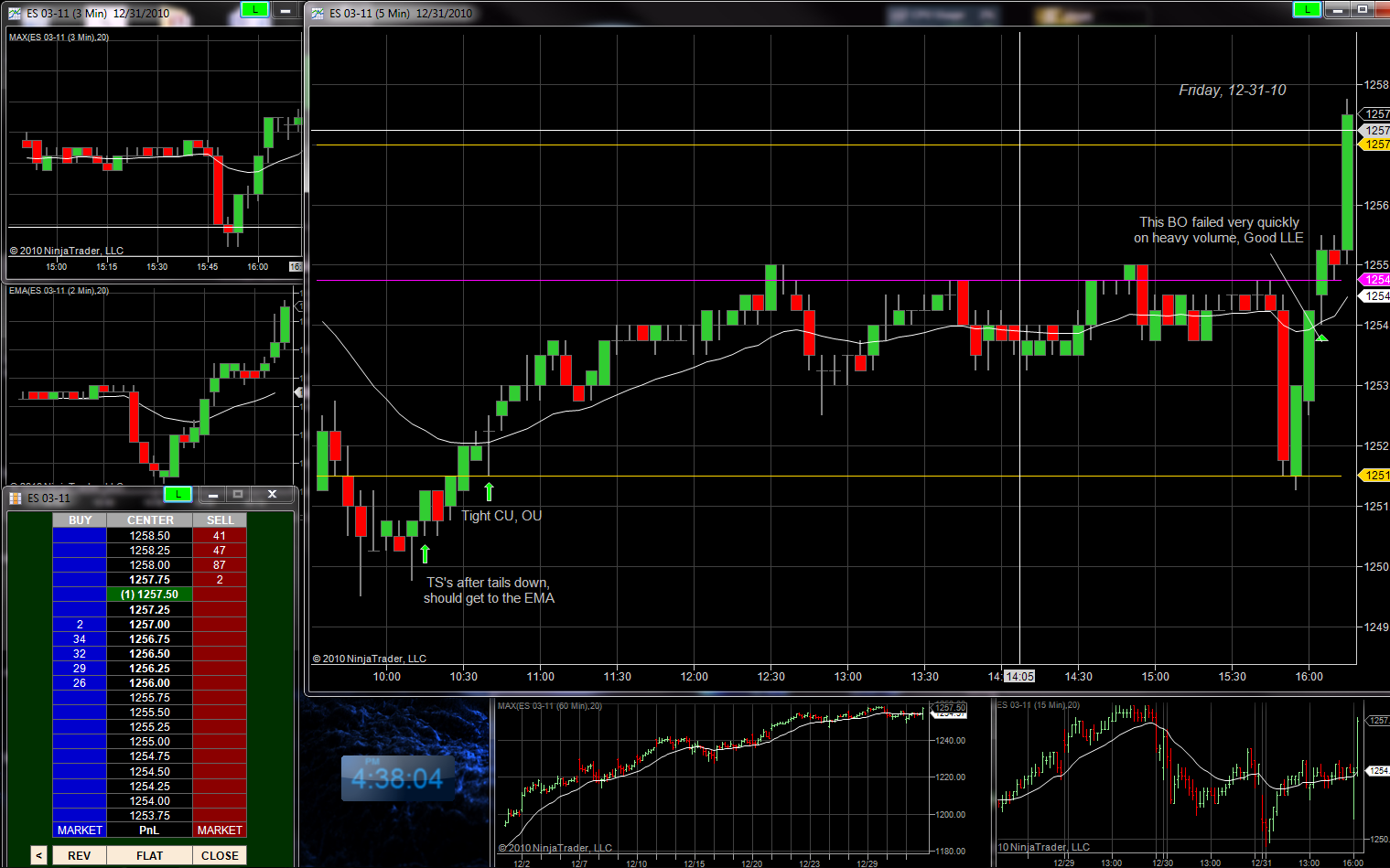
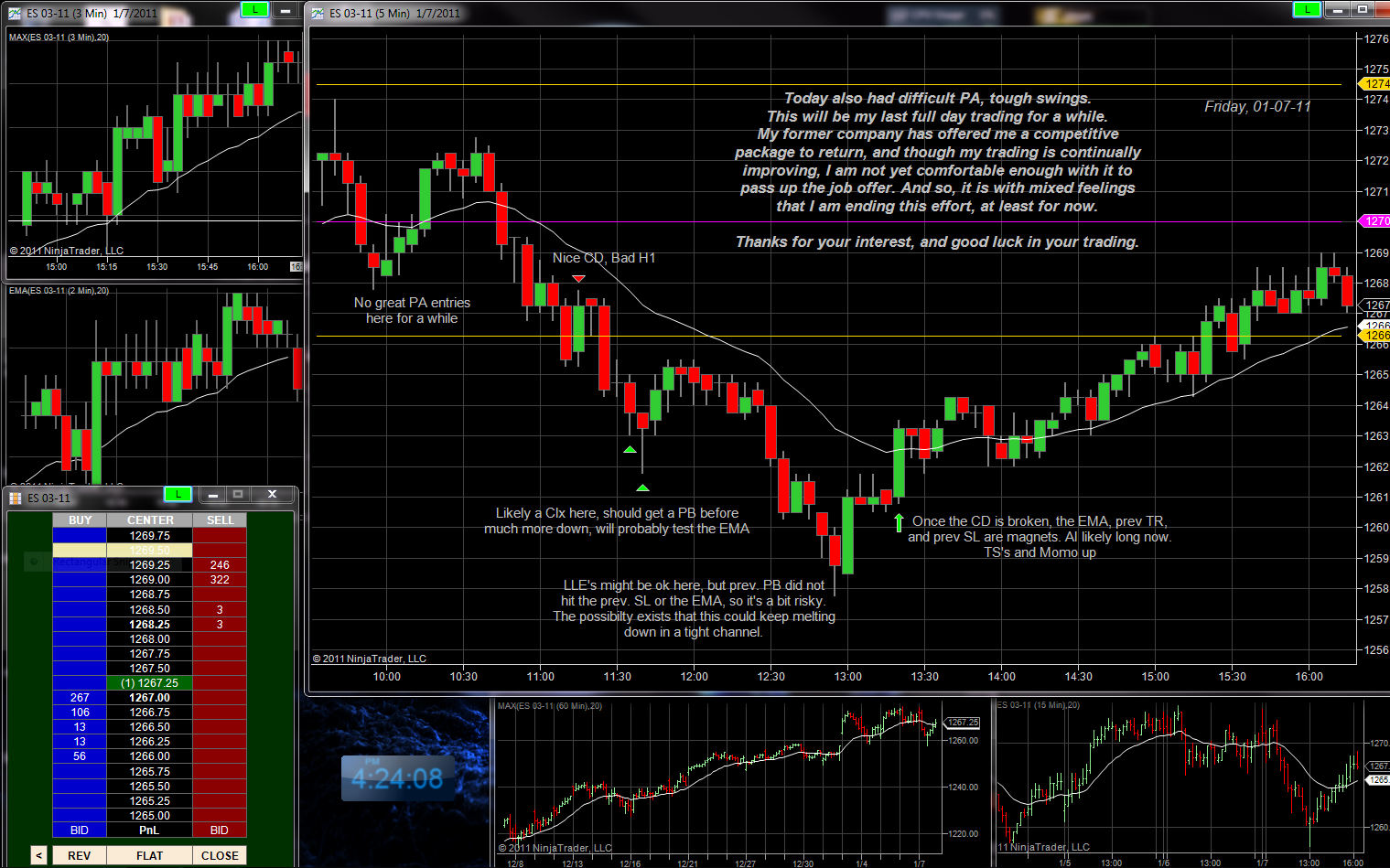
last full day of trading

So, it’s been almost one year since my last update on this small blog. This blog began as a means of keeping interest parties informed on my daily analyses of the S&P futures market. My primary mode of analysis has been price action, and though there may be thousands of individual approaches that qualify as “price action methods,” I have used numerous examples to attempt to illustrate the way I have been going about it. You can see some terms and abbreviations used in these charts here. In this post and the posts that follow, I will review my approach thus far, how it has changed in light of my new job situation as of January of 2011, and how my thoughts and aims have evolved independent of availability concerns.

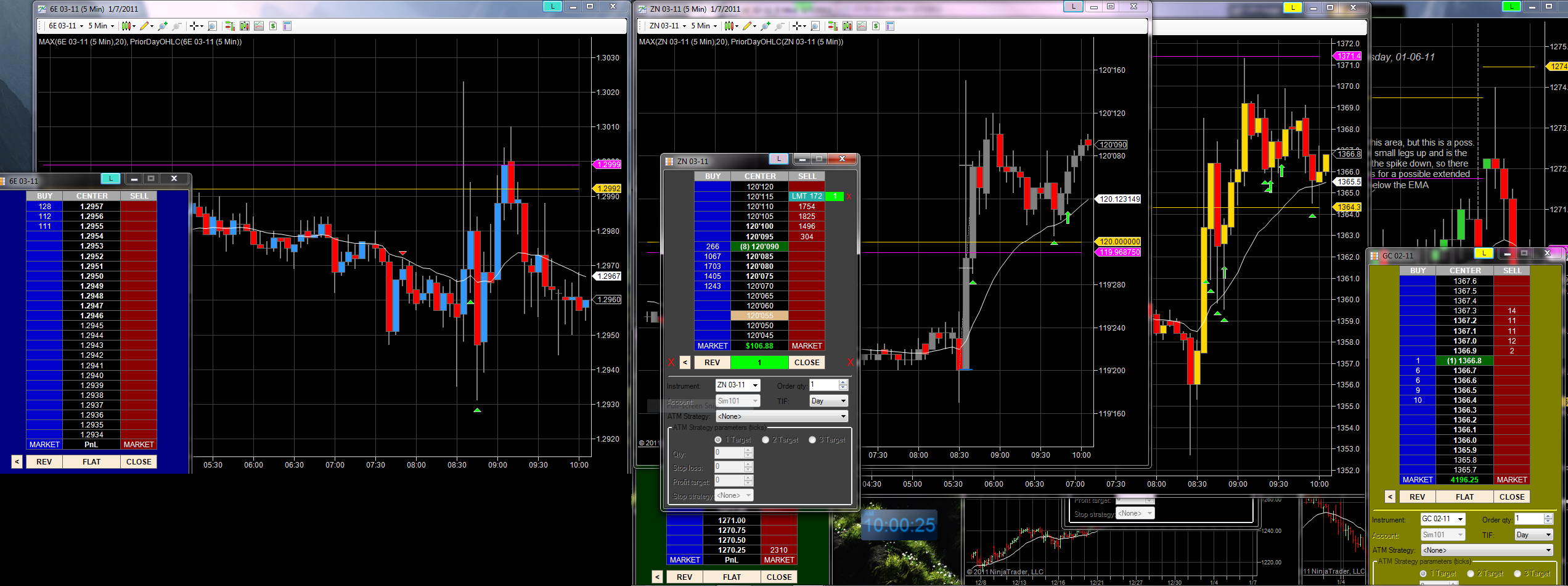
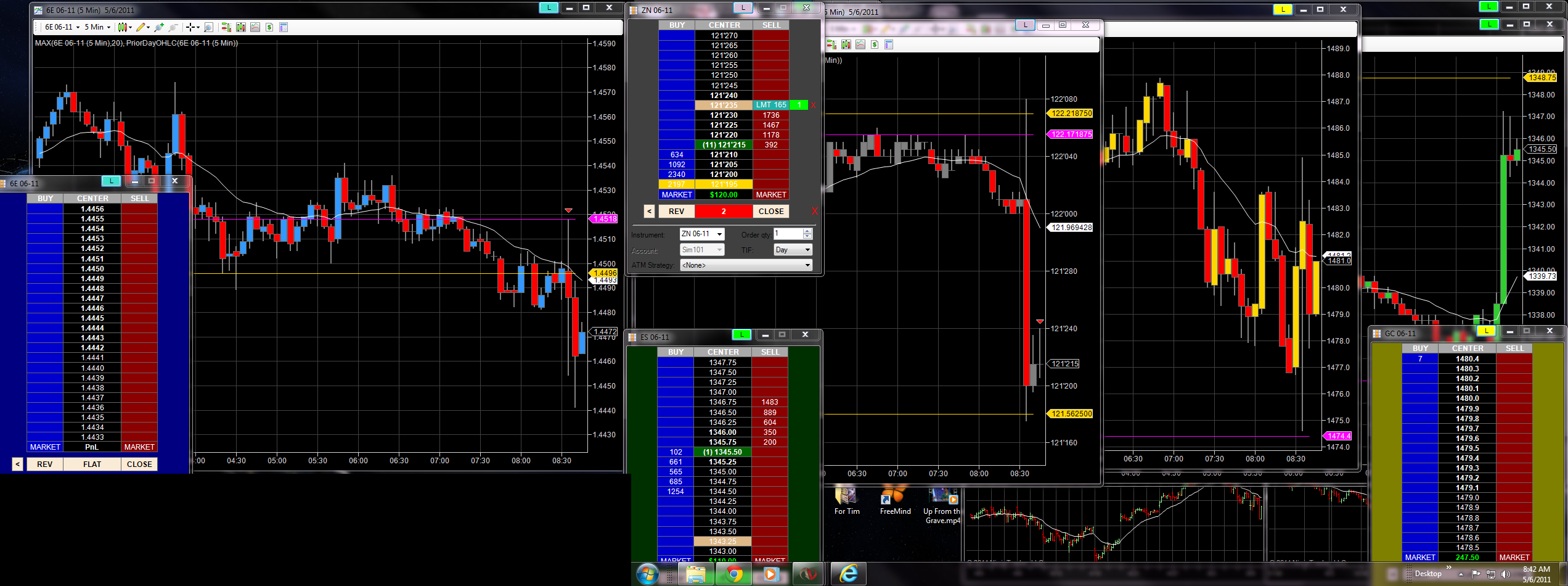
This blog has covered my analysis of the S&P, but my efforts had been expanding even during the time covered by the blog. On a few occasions I have mentioned setups in gold, the Euro, and T-notes, applying price action techniques to these other markets. In theory, price action “works” in almost any market with enough liquidity and a small-enough tick size to be trade-able, but I do think different markets have their own “personalities,” so to speak. When I first started, I was of the opinion that it was better to specialize in one market to become fluent with all of its “idiosyncrasies.” But I have since relaxed that prescription and consider the Euro, gold, T-notes, and the S&P with about equal weight in my short-term discretionary efforts. And over time, I feel that I have become familiar enough with each market’s tendencies to capitalize on opportunities in each.

That being said, I have also had a strong interest in algorithmic strategies since the beginning of my trading development. I have cycled through several platforms, from trials with Trade Navigator and MetaStock to an extensive time with TradeStation and most recently NinjaTrader. In truth, algorithmic trading is much less about the “perfect system” and much more about diversification, dynamic optimization (note that NinjaTrader supports “walk-forward” optimization), and disciplined money management. Of course you need an edge, but that alone is not enough.

These two approaches have been very distinct areas of study for some time, but my new job situation as of January of this year has changed my availability for watching the markets on an active daily basis. Further, the return to school and the recent purchase of a home have been beneficial, but have had their own time requirements.

Thus, I will be expanding this blog to reflect my combined efforts to achieve diversified, sustainable alpha, along three different paths:

1. Discretionary trading, when possible, during times of great volatility. My current favorites are monthly unemployment announcements and the Federal Reserve rate decision, for a maximum of 22 occasions every year.

2. Algorithmic trading, picking up a lot of research done in the TradeStation platform. I have migrated a lot of things to NinjaTrader because of the superior tools available, and I am actively learning C# to better utilize the platform. C# fluency also has career implications down the road, and I do plan to take on C++ in short order.

3. Options trading, looking for non-directional spreads with limited delta and gamma risk, looking to sell theta. These types of strategies look best on the final week before expiration, capitalizing on expiring options and the overnight “promotion” of the far-month (long hedging) options to near-month (short premium) options.

I will be explaining my approaches in each of these three endeavors in the posts that follow. As always, thanks for your interest, and I would greatly appreciate your feedback. It is very rare that any individual achieves success in this type of field entirely based on his or her own input.
January 10, 2012

A few sample papers…

Filed under: 2011 Update — John @ 10:39 pm

As you may know, I have been putting in some hours toward an MSF degree with New England College of Business and Finance over the last year or so. I thought this might be a reasonable place to display a few short papers I have worked on over that time. I have selected three:

The first is a short exploration of AIG, its collapse, and its post-crisis existence.

The second is a summary of arguments on the effectiveness of the Federal Reserve, with special emphasis on arguments for a “gold standard.”

The third is an investment analysis of AutoZone, Inc. (I have no AZO position.)

Feel free to let me know what you think.

(June 2013) I have added two other projects completed over the course of my MSF program to incorporate a broader body of work:

Completed early in the program, this paper is a somewhat quantitative and somewhat qualitative exploration of investment philosophy, in the form of a fictional pension fund looking for better risk-adjusted return.

And as a part of my very last class, this Excel spreadsheet was an economic analysis of financing versus leasing a new luxury automobile.

As always, feel free to contact me with comments.

December 6, 2011

2011 Update: Discretionary Report Trading

Filed under: 2011 Update — John @ 11:10 pm

So one of my most promising endeavors remains discretionary trading during times of great volatility – that is – just after reports. During these times, price action remains king, but it is usually dominated by momentum where applicable. I have found that the three major report types I follow do have their own “character.” What follows are some thoughts – some things I look for in each type of report.

1. Unemployment Report, usually 8:30 AM on the first Friday of every month. These reports generally cause more volatility in Gold, the Euro, and Treasuries than in the S&P futures, but the S&P’s can still have a good run at these times. Overall, I think that the Treasuries are the most directional in these reports, followed by the Euro and then Gold. When the S&P’s are moving, I would slot them between the Euro and Gold. For all four markets, I think it is generally good advice to wait for the first five-minute bar to form before directional trading, though I have had good experience with volatility trading in the Euro and Gold during the first few seconds and minutes. Very often, the Treasuries will have a strong directional move, and following it is simply a matter of building a position in that direction, preferably on pullbacks. Despite being the second most directional in my opinion, I think the Euro has been fairly tricky at times. It is not as easy to follow as the Treasuries, and will often “chop around” without going very far. Be very careful chasing the Euro too early – it is pretty common to see it snap back to the original area before either continuing in that direction or just going nowhere. Waiting for this “snap back,” I think, is a sound strategy. Trades in the Euro that combine directionality with volatility exploitation are best, but the Euro will often have the longest-lasting trends of the bunch. The first H1/L1 and H2/L2 after a trend are generally reliable, as are trades near the EMA. Gold has probably been my favorite market at these times, despite its reduced sense of direction. For me, Gold seems to have the optimal mix of volatility and trending, such that it offers many opportunities to capitalize on both aspects. When the S&P’s do move, my approach is very similar to that of the Treasuries. Perhaps I should say that my approach to Treasuries is that they are less-liquid S&P’s, but with stronger trending.

2. 10:00 reports that cause moves. I have followed these in the S&P the most, and I have found these to be reliable momentum plays. However, there is a higher risk of a reversal than that present in the unemployment reports. The other three markets will rarely develop their own trends based on this report, but if they do they can be traded in the manner above. Gold is usually volatile around this time anyway, and if the Euro has some movement, usually you can have some decent price action setups utilizing both trend and volatility. The EMA in both markets tends to be pretty valuable here. I think the Treasuries are the least likely to start a trend in this fashion around this time, but if they clearly do, it should be a pretty easy train to ride.

3. FOMC reports. These are my favorite reports in the S&P, and I will say that FOMC reports differ quite a bit from the price action of “regular” reports. Many have commented on the “three-leg” pattern prevalent on many FOMC charts, and while I wouldn’t necessarily look to count legs real-time, you will very likely see about two major reversals on an FOMC chart. I would say that a strong S&P trend in one direction for the rest of the day is very unlikely, but if it does happen it will likely not be a noisy report. During these reports the S&P trends the least but has the best price action. Many signals are more reliable and quite easy to read. Volatility plays set up nicely, and the market usually respects an average daily range.

November 20, 2011

Terms and Abbreviations Link

Filed under: Daily Setups — John @ 8:36 pm

Please note that I have moved the “Terms and Abbreviations” post here to clean up the front page a bit. It is still categorized under Supplemental Info.

January 8, 2011

1-07-11 Setups

Filed under: Daily Setups — John @ 12:43 pm

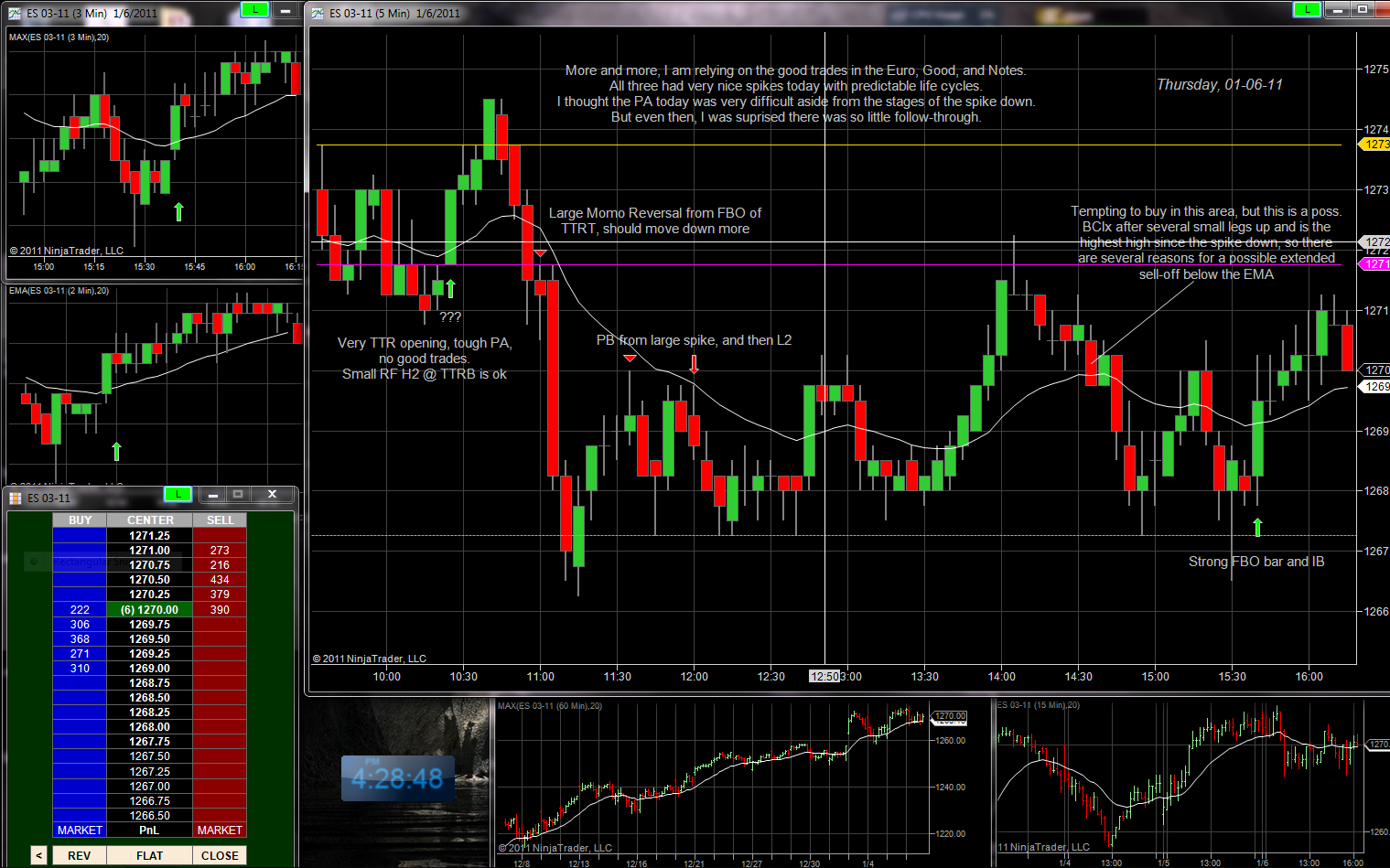
1-06-11 Setups

Filed under: Daily Setups — John @ 12:42 pm

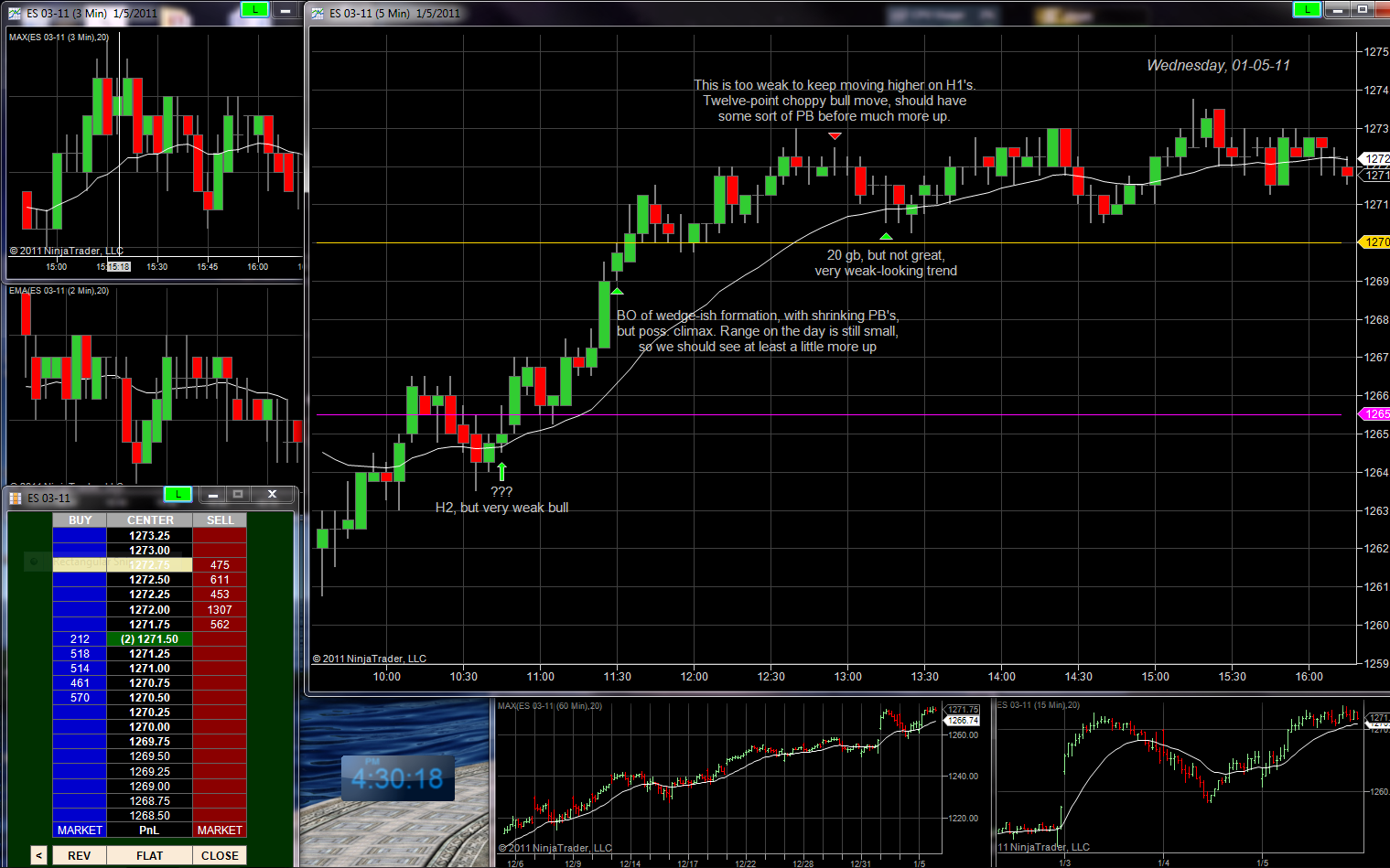
1-05-11 Setups

Filed under: Daily Setups — John @ 12:41 pm

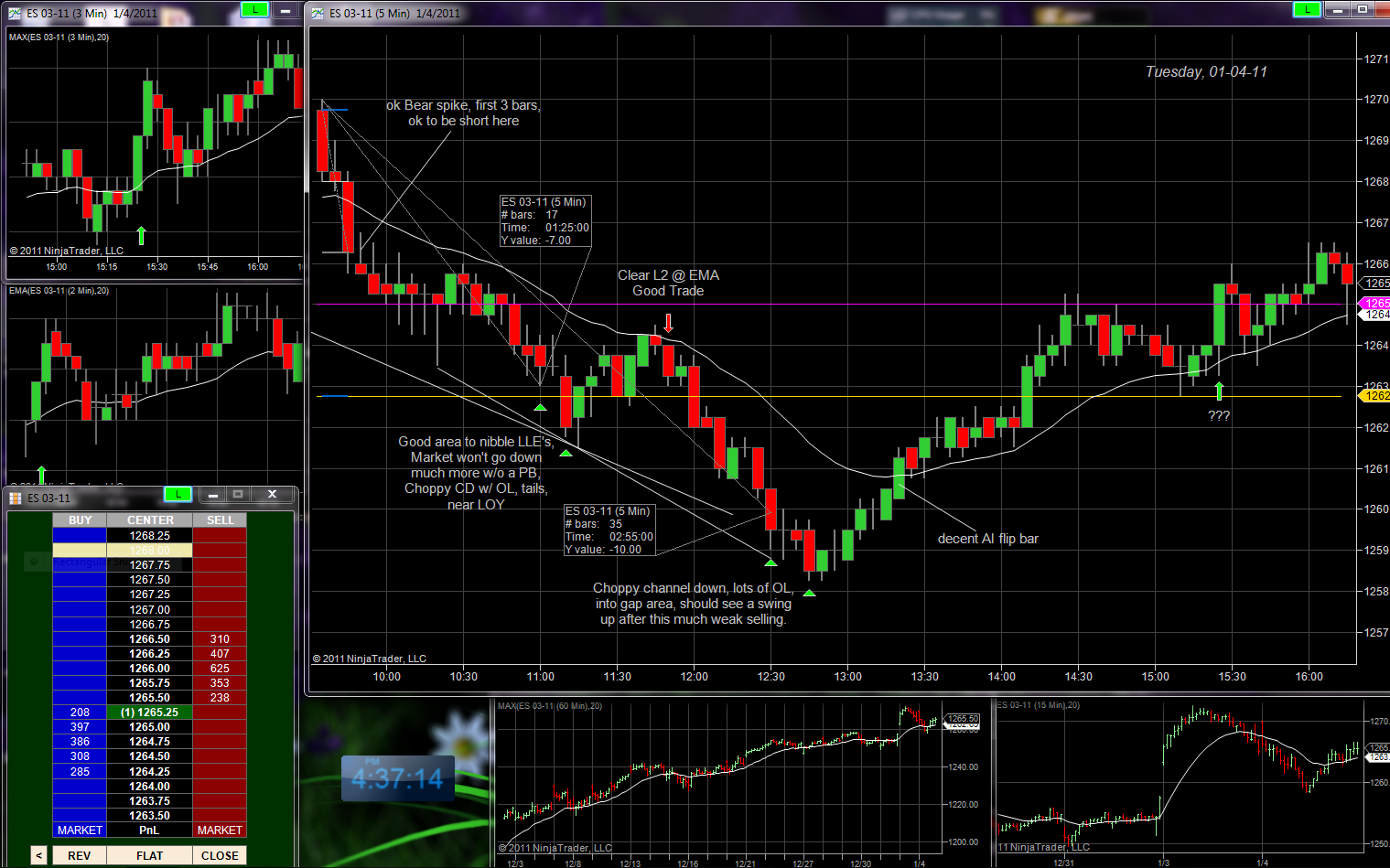
1-04-11 Setups

Filed under: Daily Setups — John @ 12:40 pm

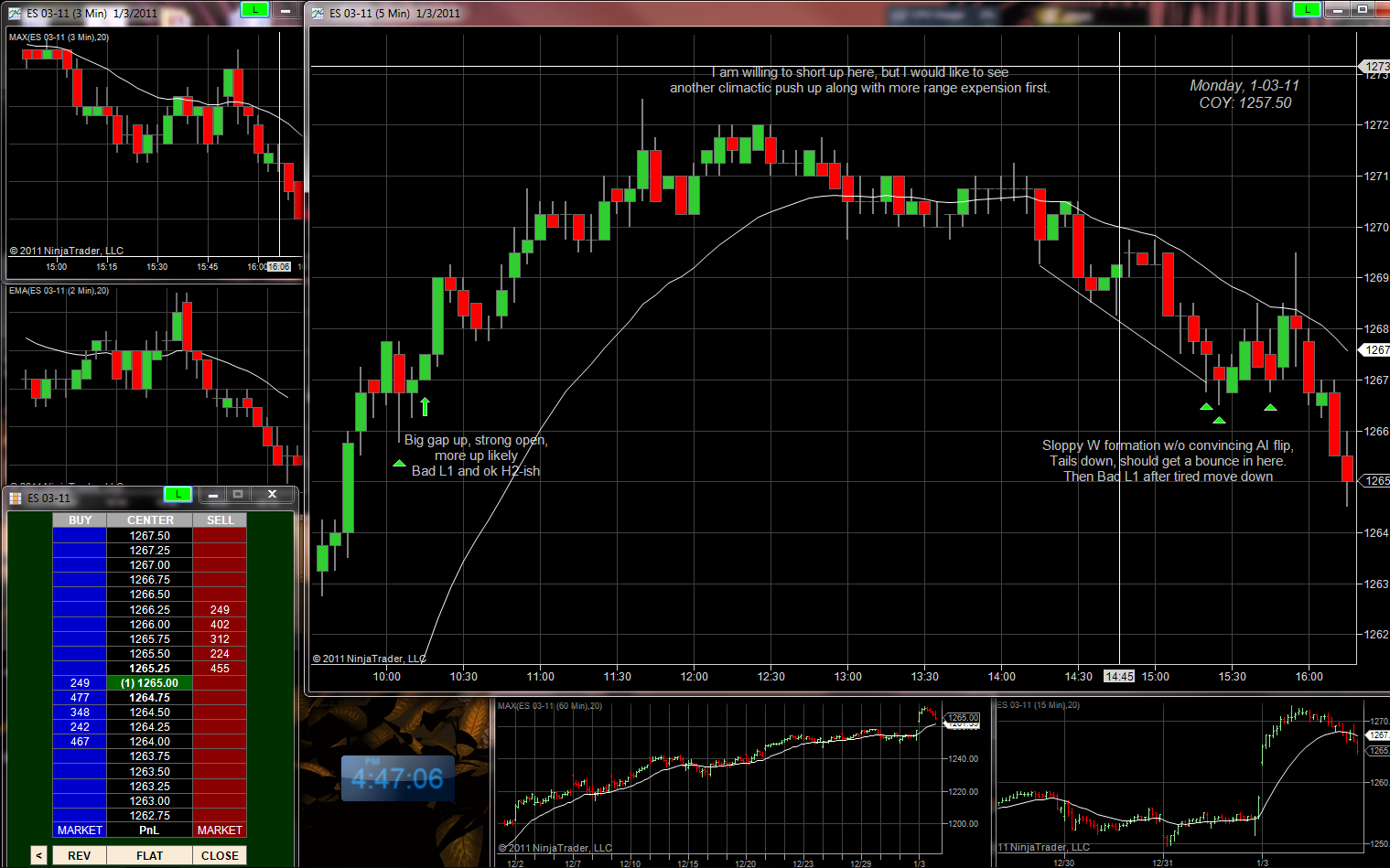
1-03-11 Setups

Filed under: Daily Setups — John @ 12:35 pm

12-31-10 Setups

Filed under: Daily Setups — John @ 12:34 pm

Older Posts »

Blog at WordPress.com.